Separate logistics
When to use
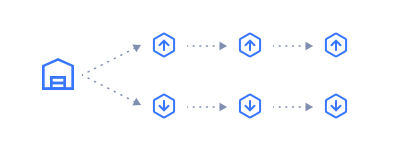
Separate logistics means splitting cargo pickup and delivery tasks between different vehicles. The fleet is divided into two segments:
- transport that only picks up cargo from clients;
- transport that only delivers cargo to clients.
Separate logistics pays off most when:
- there are many orders in a small area;
- a lot of time is spent at the warehouse — in queues, on paperwork, or on loading and unloading.
Separate logistics helps to minimize the number of warehouse visits: it comes down to one visit per day.
Diagram
How to implement
By setting requirements for performers.
Examples
Example 1
We know how many vehicles we can use for delivery and how many for picking up cargo from clients.
- The order order_client_pickup has the performer requirement performer_restrictions = pickup.
- The order order_client_drop has the performer requirement performer_restrictions = drop.
Planning builds 2 routes:
- The first route is handled by the driver with performer_features = pickup, who serves the order order_client_pickup.
- The second order is carried by the driver with performer_features = drop.
Example 2
We do not know how many vehicles can be assigned to delivery and how many to pickup.
The order with the key order_client_drop has the requirement order_restrictions = drop. This means that only an order with order_features = drop can join the trip with this order.
The order with the key order_client_pickup has the requirement order_restrictions = pickup. This means that only an order with order_features = pickup can join the trip with this order.
According to these requirements, planning builds 2 routes.